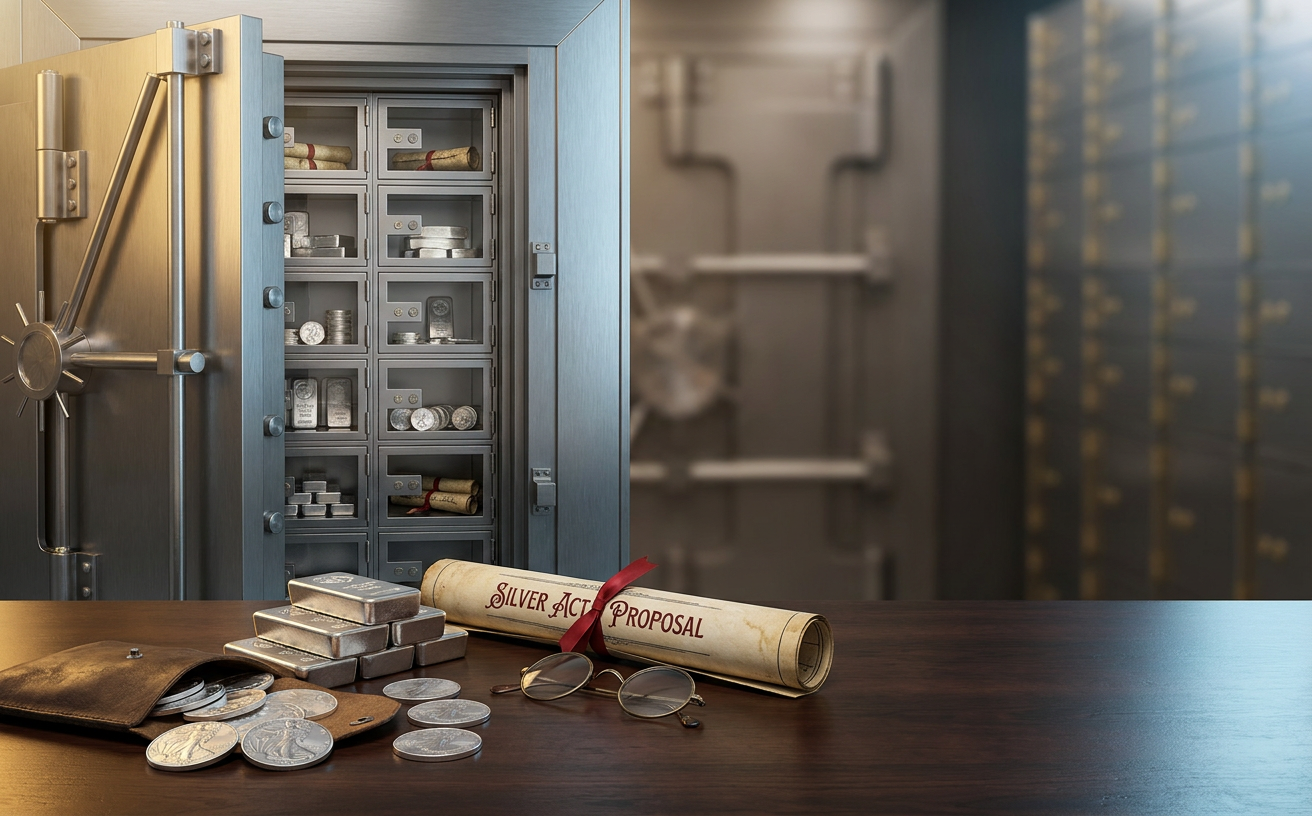
Storing Precious Metals at Home vs. Using a Vault Service

The Storage Decision Most New Investors Underestimate
For many entering the world of physical precious metals, the focus is almost entirely on the acquisition: which coins to buy, which bars offer the best premium, and when to execute the purchase. These are important questions. However, the decision that follows—where to store your gold and silver—is arguably more critical. It is a decision that profoundly shapes your risk exposure, ongoing costs, ability to insure your assets, and, in the case of retirement accounts, the very legality of your holdings.
Buying the metal is the transaction; storing it is the long-term commitment. Yet this crucial step is often treated as an afterthought. An inadequate storage strategy can negate the entire purpose of owning physical metals as a store of value and a safe-haven asset. The security of your investment is not just in the metal itself, but in the system you choose to protect it.
This guide offers a complete, unbiased comparison between the two primary storage methodologies: keeping your metals at home versus using a professional vault or depository service. We will examine the pros, cons, costs, and security implications of each, providing a clear framework for making an informed decision tailored to your specific circumstances. With gold trading near $5,250 per ounce and silver at $93.50 in this 2026 market, a holding of even modest size represents a significant concentration of value, demanding a commensurate level of planning and diligence.
Option 1: Storing Metals at Home
Home storage is often the default choice for new investors. It encompasses a range of solutions, from the simple to the complex. At its most basic, it might mean hiding a few coins in a drawer or a fireproof bag. More sophisticated setups involve high-security, professional-grade safes. The term "home storage" can also extend to locations under your direct personal control but not inside your primary residence, such as a safe at a trusted relative's house or a locked cabinet in a workshop. The defining characteristic is that you, and you alone, control access to the physical location without needing permission from a third-party commercial entity.
Pros of Home Storage
- Direct physical access — This is the most cited benefit. You can see, touch, and access your metals 24/7/365 without requesting permission, filling out paperwork, or waiting for business hours. There is no third party standing between you and your assets.
- Privacy — When you take direct delivery, the transaction with your dealer is the end of the paper trail. No vaulting company holds a record of your specific holdings, quantities, or personal information, offering a level of privacy that is impossible with third-party storage.
- No annual storage fees — Aside from the initial setup costs (such as purchasing a safe), there are no recurring annual fees calculated as a percentage of your holdings. For long-term holders, this can represent significant savings over decades.
- Immediate availability in a crisis or emergency — If you need to "grab and go" or access your wealth during a natural disaster, power outage, or banking holiday, your metals are immediately at hand. This appeals to those who view precious metals as a form of ultimate emergency currency.
- Suits small-to-mid holdings — For investors with total holdings in the $5,000 to $50,000 range, the cost and complexity of professional vaulting may be disproportionate. A secure home setup can be a very practical and cost-effective solution for these smaller positions.
Cons of Home Storage
- Theft and burglary risk — This is the most significant and obvious risk. Your home is a softer target than a professional vault. A concentration of high-value metals makes you a potential target for burglary. Silver presents a unique problem due to its lower value density; a $50,000 holding of silver is nearly 540 ounces, or over 33 pounds, making it bulky and difficult to conceal effectively. Gold is more portable but also more universally recognized by thieves.
- Fire and flood damage — While gold and silver are resistant to damage, extreme heat in a house fire can melt coins and bars, making them difficult to identify and value without a professional assay. It can fuse them together or to the container they are in. Flooding can also cause cosmetic or identifying damage, particularly to packaging and any numismatic value. li>Homeowners insurance typically offers negligible coverage — This is a critical, often misunderstood, point. A standard homeowners or renters insurance policy typically caps coverage for "money, bank notes, bullion, and coins" at a very low limit, often between $200 and $1,500 total. Your $50,000 holding is therefore almost entirely uninsured against theft or fire.
- Operational security risk — The greatest threat to home storage security is often human, not mechanical. Casually mentioning your gold holdings, even to trusted friends or family, creates a security risk. The more people who know, the higher the risk of that information falling into the wrong hands. This "op-sec" is a constant burden.
- NOT permitted for IRA-held metals — Under United States tax law, precious metals held within an Individual Retirement Account (IRA) cannot be stored at home or in your personal possession. Doing so is considered a distribution and can trigger severe tax consequences. This is a non-negotiable legal requirement we will explore in detail later.
What a Quality Home Setup Actually Looks Like
Simply hiding your metals or placing them in a cheap, portable "fireproof" box from an office supply store is not a secure strategy. A proper home storage solution for a meaningful amount of bullion is a significant investment in itself. It begins with the safe. A quality safe should carry, at a minimum, a TL-15 or, preferably, a TL-30 rating from Underwriters Laboratories (UL). This rating signifies the tool resistance of the safe door: a TL-15 safe can resist expert attempts at entry using common tools for at least 15 minutes, while a TL-30 resists for 30 minutes. These safes are heavy, expensive, and made of solid steel plate, not thin sheet metal.
The safe must be professionally installed and bolted into a concrete foundation or structurally significant part of your home to prevent it from simply being carried away. It should also have a fire rating of at least one hour (e.g., 1,700°F for 60 minutes) to protect the contents from fire damage. Finally, the safe should be installed in a discreet, concealed location—not in a place of prominence like a home office.
Even with the best safe, you must address the insurance gap. This requires contacting your insurance provider to add a scheduled personal property rider or a separate policy specifically covering your precious metals for their full appraised value. This will involve an additional annual premium and likely require proof of purchase and a description of your storage setup.
The total cost for a properly rated, installed safe and the first year's insurance rider can easily range from $1,500 to over $5,000. This is the true "cost" of secure home storage, and it must be factored into your decision.
Option 2: Vault and Depository Storage
Professional storage involves entrusting your metals to a specialized third-party company. These facilities are purpose-built to protect high-value assets. The options range from familiar bank safe deposit boxes to highly secure, non-bank private vaults and IRS-approved depositories. Prominent names in the depository space include Delaware Depository, Brink's, International Depository Services (IDS), A-M Global Logistics, and Loomis. These are not metal dealers; they are security and logistics firms that provide secure warehousing. Private vaulting services, which can be domestic or international (e.g., in Switzerland, Singapore, or the Cayman Islands), are offered by companies like Malca-Amit, Brink's Global Services, and bullion dealers with integrated storage programs like GoldMoney or BullionStar.
Allocated vs. Unallocated vs. Pooled Storage
When using a depository, understanding the account structure is paramount. This distinction is more important than the name on the building.
- Allocated: This is the gold standard. In an allocated account, specific, identifiable bars or tubes of coins are titled directly in your name and are set aside for you. The depository is merely the custodian of your property. Your holdings are segregated from the depository's operational assets and are not on its balance sheet. This makes your metals "bankruptcy-remote" — if the depository company were to fail, your claim is to the specific metal, not to the company's assets. You are not a creditor; you are the owner.
- Unallocated/Pooled: In an unallocated account, you do not own specific bars or coins. Instead, you own a claim against a pool of metal held by the institution. You are a creditor to the vaulting company. If the company fails, you get in line with other creditors to claim your share of the remaining assets. While often cheaper or even free, unallocated storage carries significant counterparty risk and is generally not recommended for investors whose primary goal is to remove their assets from the financial system's chain of liabilities.
For any serious holding intended as a long-term store of value or safe-haven asset, allocated storage is the only appropriate choice.
Segregated vs. Commingled Storage
Within allocated storage, there is a further distinction:
- Segregated Storage: Your exact items—the specific serial-numbered bars or sealed monster boxes you purchased—are held in a private, named compartment or location within the vault. Nobody else's metal is mixed with yours. This offers the highest level of accountability and is preferred for large bar holdings or numismatic items.
- Commingled Storage: Your assets are stored alongside identical items from other clients. For example, your 20 American Gold Eagles are added to a vault location that holds thousands of other clients' American Gold Eagles. When you request a withdrawal, you receive 20 a-brand-new.jpgn-new-mint-condition American Gold Eagles, but not necessarily the exact ones you deposited. This is perfectly acceptable for modern, fungible bullion coins and is typically less expensive than segregated storage.
Annual fees for segregated storage typically range from 0.30% to 0.60% (30 to 60 basis points) of the asset value, while commingled storage is often in the 0.10% to 0.30% (10 to 30 basis points) range, usually with an annual minimum fee.
Pros of Vault Storage
- Insurance: This is arguably the greatest benefit. Reputable depositories carry comprehensive, all-risk insurance policies (often through syndicates like Lloyd's of London) that cover your holdings for their full replacement value. This insurance covers theft, damage, and mysterious disappearance—risks that are nearly impossible to insure fully at home.
- Required for IRA metals: As mandated by the IRS, if you are holding precious metals within a Self-Directed IRA, you must use an approved third-party depository. This is not optional.
- Professional security: These facilities are purpose-built fortresses with Class III or UL-listed vaults, 24/7 surveillance, armed guards, biometric access controls, and protocols honed by decades of experience protecting billions in assets. This level of security is unattainable for an individual.
- Easier to liquidate: When it's time to sell, having your metals in a recognized depository simplifies the process. Many large dealers can purchase your holdings directly from your depository account, with the funds wired to you. The metal never needs to be shipped, verified, and re-assayed, making for a faster, cheaper, and more efficient transaction.
- Estate planning simplicity: A depository account provides a clear, auditable paper trail of your holdings. This simplifies estate planning, probate, and the process of passing assets to beneficiaries. Transferring ownership is a matter of legal paperwork, not locating a hidden safe.
Cons of Vault Storage
- Annual fees: Professional storage is not free. You will pay an annual fee, typically calculated as a percentage of the value of your holdings, plus potential minimums. These fees, though small, compound over time.
- Counterparty/bankruptcy risk: This risk is significant with unallocated storage. Even with allocated storage, you are placing trust in the depository's management and operational integrity. Diligent research into the company's financial health and reputation is essential.
- Less direct access: Your metals are not in your hands. Accessing them requires a formal request, and receiving a shipment can take several business days. It is not suitable for "in case of emergency tonight" scenarios.
- Reporting visibility: The depository knows what you hold. While these records are private, they do exist. For investors seeking absolute anonymity, this is a drawback. Furthermore, these holdings may be subject to government reporting requirements, depending on jurisdiction.
- Geographic concentration risk: Many of the largest U.S. depositories are located in Delaware and New York. While secure, this creates a point of geographic concentration that some investors may wish to diversify by using vaults in other regions or countries.
Bank Safe Deposit Boxes: A Word of Caution
It's tempting to see a bank safe deposit box as a cheap and convenient middle ground. It is not. The contents of a safe deposit box are not insured by the FDIC or any other government agency. Furthermore, the bank's own contract that you sign explicitly states that the bank is not liable for loss or theft from the box, except in cases of gross negligence. There are documented cases of boxes being lost, stolen by employees, or even drilled open and emptied by the bank itself during branch consolidations. A safe deposit box is acceptable for storing documents or items of sentimental value, but it is not a recommended solution for storing a significant position in precious metals.
The IRA Rule You Cannot Ignore
The issue of storing IRA-held metals at home is one of the most contentious and misunderstood topics. The law, however, is clear. Internal Revenue Code (IRC) Section 408(m) specifies that for an IRA to own physical bullion, the metal must be held in the "physical possession of a trustee," which must be an IRS-approved bank or non-bank custodian. This means an approved depository.
Some promoters have marketed "home storage IRAs," often using a complex LLC structure where the IRA owner is the manager. The IRS has consistently challenged this interpretation. The landmark 2021 U.S. Tax Court case, McNulty v. Commissioner, provided a decisive ruling. The court found that an IRA owner taking personal possession of IRA-purchased coins constituted a taxable distribution from the IRA. If the owner is under age 59½, this also triggers a 10% early withdrawal penalty. Storing your IRA metals at home effectively disqualifies the IRA, resulting in a potentially massive and immediate tax bill.
Cost Comparison: A Realistic Example
Let's consider a hypothetical $100,000 holding in gold (approximately 19 ounces at $5,250/oz). Here is how the storage costs might break down:
- Home storage: A one-time cost of approximately $3,000 for a professionally installed TL-30 rated safe. Plus, an ongoing insurance rider might cost around $300 per year (assuming a rate of $0.30 per $100 of value). The ongoing cost is ~$300 per year.
- Allocated depository: A typical annual fee for segregated, allocated storage might be 0.50% of the asset's value. For a $100,000 holding, this would be $500 per year. This fee includes full insurance coverage.
- Bank safe deposit: The annual rental for a box large enough could be $100–$300. However, this is for uninsured storage, making it an apples-to-oranges comparison.
Initially, home storage has a high upfront cost, but a lower annual cost. The depository has no upfront cost but a higher annual fee. The breakeven point where the total cost of home storage (safe + cumulative insurance) equals the cumulative cost of depository storage often occurs around the 7-10 year mark. The right choice depends less on pure cost and more on your priorities regarding access, insurance, IRA compliance, and risk tolerance.
A Common Hybrid Approach
For many seasoned investors, the debate is not "either/or" but "how much of each?" A popular and prudent strategy is to use a hybrid approach. This involves keeping a small portion of your total holdings—perhaps 10-20%—in a secure home storage setup. This portion, often comprising fractional gold coins and smaller silver bars or rounds, serves as your emergency fund, accessible at a moment's notice. The bulk of your holdings, the core of your wealth preservation strategy, is then stored in a fully insured, allocated account at a professional depository. This approach diversifies your storage risk in the same way you diversify your investments, giving you the best of both worlds: immediate liquidity and professional-grade security.
Practical Checklist Before You Decide
- Is any portion held inside an IRA? If yes, an IRS-approved depository is mandatory for that portion. This is the first and most important question.
- What is the total value? For holdings under $25,000, a proper home safe setup can be a very effective solution. For holdings exceeding $100,000, the insurance, security, and estate benefits of professional vaulting become increasingly compelling.
- What is your homeowners policy's precious-metals limit? Don't assume. Find your policy document and read the specific clause on "money, bullion, and securities." You will likely be surprised by the low limit.
- Who knows you own it? Be honest with yourself about your operational security. The fewer people who know, the safer you are. If discretion is not your strong suit, home storage carries a higher risk.
- What is your liquidation plan? How do you plan to sell your metals one day? Holdings in a recognized depository are part of the professional dealer network and are generally much simpler, faster, and cheaper to sell.
Key Takeaways
- The storage decision is as critical as the purchase decision, impacting risk, cost, and legality.
- Home storage offers ultimate access and privacy but carries significant risks of theft and fire, and standard insurance is inadequate. A proper setup is expensive.
- Professional vaulting provides full insurance and institutional-grade security but involves annual fees and reliance on a third party.
- For IRA-held metals, using an IRS-approved depository is legally required. The McNulty v. Commissioner case affirmed that home storage of IRA metals is a taxable distribution.
- Always choose allocated storage to ensure you own the metal directly, making it remote from the depository's bankruptcy risk. Unallocated storage makes you a creditor.
- A hybrid strategy—storing a small emergency portion at home and the majority in a professional depository—is a common and prudent approach for many investors.
Frequently Asked Questions
Is home storage of IRA gold legal?
No. According to the IRS and as confirmed by the U.S. Tax Court in McNulty v. Commissioner (2021), taking personal possession of precious metals purchased within an IRA is considered a taxable distribution. To remain in compliance, IRA-owned bullion must be held by an IRS-approved trustee at a third-party depository.
What does "allocated" storage mean?
Allocated storage means that specific, identifiable coins or bars are owned by you and are simply being held in custody by the vaulting facility. The metal is your direct property and is kept off the depository's balance sheet, protecting you in the event of the company's financial failure. It is the opposite of "unallocated" storage, where you are an unsecured creditor with a claim on a general pool of metal.
Are bank safe deposit boxes insured?
No. This is a common misconception. The contents of a safe deposit box are not insured by the FDIC or by the bank itself. The rental agreement you sign with the bank explicitly states that the bank is not responsible for the contents. To insure items in a safe deposit box, you would need to purchase a separate, private insurance policy.
What is a TL-30 safe?
A TL-30 rating is a security standard from Underwriters Laboratories (UL) for safes. It means the safe door has been tested and certified to resist entry for a net time of 30 minutes by professionals using common mechanical and electrical tools, such as drills, pickaxes, and grinders. It is a high security rating for a residential or commercial safe, offering significant protection against burglary.
How much does vault storage typically cost?
Annual fees for professional, insured, and allocated vault storage typically range from 0.10% to 0.60% of the total value of the metal being stored. The rate depends on the total value (higher values often get lower rates), the type of metal (silver is bulkier and may cost more), and the storage type (commingled is cheaper than segregated). Most depositories also have a minimum annual fee, often in the range of $100 to $250.
Can I store metals in another country?
Yes, storing precious metals internationally is a common strategy for geographic diversification. Reputable private vaults exist in politically and economically stable jurisdictions like Switzerland, Singapore, Hong Kong, and the Cayman Islands. However, U.S. taxpayers must be mindful of reporting requirements. Holdings in foreign financial accounts, which can include vault accounts, may need to be reported annually to the IRS on FinCEN Form 114 (FBAR) and/or IRS Form 8938 (FATCA), depending on the total value.
Sources
Found this article helpful?
Take Our 1-Minute Gold IRA Match Quiz
Get a personalized recommendation based on your goals and investment style.
Explore Related Topics
For investors who don't have time to chase headlines.
Subscribe to The Precious Metals Report
Everything That Matters. Nothing That Doesn't.
No hype. No noise.
Just industry news — distilled into a short, scannable email.
✔ Price moves ✔ Market drivers ✔ Actionable insights

Vincent Edwards
Our editorial team covers education for Precious Metals Report, focused on clear, unbiased reporting and investor education.
Read more from this author