How AI and Data Centers Are Driving New Demand for Silver and Copper
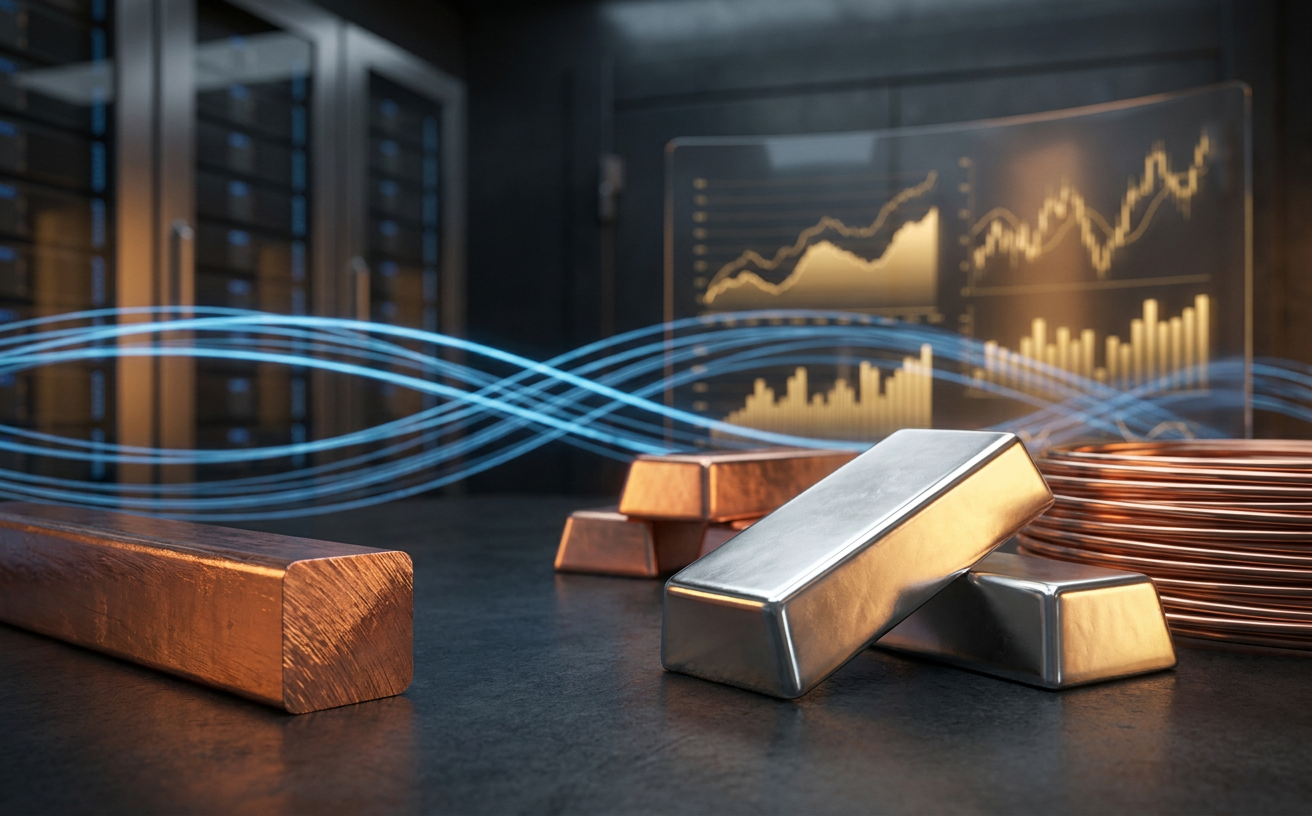
Key Takeaways
- 1The AI and data center boom requires a massive physical infrastructure buildout, driving demand for key industrial metals.
- 2Silver is crucial for energy efficiency in servers, connectors, and the solar panels that increasingly power data centers.
- 3Copper forms the backbone of electrical systems, from internal data center wiring to the extensive grid-scale upgrades required to support them.
- 4Analysts project this new demand will consume tens of millions of ounces of silver and thousands of tons of copper annually.
- 5Supply for both metals is constrained, with long lead times for new mines and growing geopolitical risks, creating a tight market.
- 6This trend provides a strong, non-speculative demand floor, adding a new dimension to the investment case for silver and copper.
The digital world, for all its abstract concepts of clouds and networks, is built upon a foundation of physical materials. As the world economy continues its rapid digitization, a new and powerful trend has taken center stage: the artificial intelligence revolution. The generative AI boom, which accelerated dramatically in 2024 and 2025, is not just about sophisticated algorithms. It is driving a global race to build and upgrade the physical data centers that power these technologies, creating a significant and often overlooked demand driver for two essential metals: silver and copper.
The Unseen Material Costs of the AI Revolution
The computational power required to train and run advanced AI models is staggering, far exceeding that of traditional data processing. This has triggered a global infrastructure build-out by tech giants like Amazon, Google, Microsoft, and others, with capital expenditures on data centers reaching hundreds of billions of dollars. This expansion has a voracious appetite for energy. Analysts from the International Energy Agency (IEA) have projected that electricity consumption from data centers could double between 2022 and 2026.
This massive energy requirement creates a two-fold demand for metals. First, the data centers themselves must be built with components that are as energy-efficient as possible to manage both costs and heat. Second, the electrical grids that supply these facilities require significant expansion and reinforcement. This is where the unique properties of silver and copper become indispensable.
Silver's High-Tech Role in a Low-Carbon Future
While historically prized as a monetary metal, silver's role as an industrial commodity has become increasingly important. It possesses the highest electrical and thermal conductivity of any metal, making it essential in applications where efficiency and performance are paramount.
Inside the Data Center
Within the high-performance servers that power AI, silver is a critical component. It is used in contacts, connectors, and printed circuit boards to ensure reliable, low-resistance electrical pathways. This minimizes energy loss as heat, a crucial factor in densely packed server racks. As processing demands increase, the need for components that can handle higher electrical loads without overheating grows, reinforcing silver's role. Tech companies are willing to pay a premium for silver's superior performance because the cost of energy over a server's lifespan far outweighs the initial material cost.
The Solar Synergy
The immense power needs and ESG (Environmental, Social, and Governance) commitments of big tech have led to a parallel boom in renewable energy investment, particularly solar. Major cloud providers are now among the largest corporate buyers of renewable energy, often building dedicated solar farms to power their data centers. Silver, in the form of a paste, is a key component in the photovoltaic (PV) cells of nearly all silicon-based solar panels. In late 2025, analysts at The Silver Institute estimated that the combined demand from data center electronics and the associated solar infrastructure build-out could exceed 150 million ounces of silver annually by 2028. With total global silver demand hovering around 1.2 billion ounces, this represents a major new demand category.
Copper: The Backbone of Electrification
If silver is the high-performance specialist, copper is the workhorse. Its primary role is not in the micro-level circuitry but in the macro-level electrical infrastructure that makes it all possible. Copper's combination of conductivity, durability, and cost-effectiveness makes it the global standard for wiring.
A single large-scale data center can require hundreds of tons of copper for its internal power distribution systems, busbars, grounding wires, and data cables. However, the larger demand story lies outside the facility itself. Connecting a new gigawatt-scale data center campus to the grid often requires building new substations, installing large transformers, and running miles of high-voltage transmission lines—all of which are incredibly copper-intensive.
This AI-driven demand acts as a powerful accelerant to the existing electrification trend fueled by electric vehicles and grid-scale renewable energy projects. This dynamic can be compared to the massive infrastructure build-outs of the past, such as the electrification of America in the early 20th century or China's urbanization boom in the 2000s, both of which led to sustained bull markets for copper. As of early 2026, many market analysts are pointing to a structural deficit in the copper market, where demand is consistently outpacing new supply.
Supply Constraints and Geopolitical Considerations
A surge in demand does not occur in a vacuum. Both silver and copper markets face significant supply-side challenges. New large-scale copper mines can take over a decade to permit and build. Similarly, most of the world's silver is produced as a by-product of mining for other metals like copper, lead, and zinc. This means silver supply is inelastic—it cannot be ramped up quickly simply because AI demand surges.
Furthermore, mining is an increasingly complex business. Declining ore grades at existing mines mean more rock must be processed to yield the same amount of metal. Resource nationalism in key producing countries, particularly in Latin America, adds a layer of political risk to supply forecasts. This fundamental tension between surging, high-tech demand and a constrained, slow-moving supply picture provides a strong basis for price support.
An Investor's Perspective in 2026
For investors, this trend solidifies the fundamental case for holding industrial metals. Unlike more speculative narratives, this demand is tangible, backed by the capital expenditures of the world's most valuable companies.
For silver, this adds another powerful element to its unique investment thesis. The metal retains its age-old role as a hedge against currency debasement and a store of value, a quality that supported its rally above $40 per ounce in 2025. This new industrial demand provides a high and rising price floor, underpinning its monetary value with tangible utility. The strong demand has been a key factor in the narrowing of the gold-to-silver ratio from its highs in previous years.
In contrast, other precious metals like platinum are driven by different forces. While also an industrial metal, platinum's primary demand comes from the automotive sector for catalytic converters. As of 2026, it continues to trade at a steep discount to gold, which analysts at the World Gold Council (WGC) note has exceeded $4,000 per ounce, while platinum has found it challenging to secure a foothold above $1,200 per ounce.
Bottom Line
The rise of artificial intelligence is not just a technological phenomenon; it is a powerful catalyst for the physical world. The construction of data centers and the required energy infrastructure represents one of the most significant industrial undertakings of this decade. This creates a structural, long-term demand driver for both silver and copper, layering on top of existing clean energy trends.
This industrial demand is real, measurable, and set against a backdrop of constrained supply. For investors, this dynamic highlights the essential role these metals play in building the future. To gauge the pace of this trend, market watchers should closely monitor the quarterly capital expenditure reports from major tech firms, global inventories at exchanges like the CME and the London Bullion Market Association (LBMA), and production guidance from the world's leading mining companies.
Found this article helpful?
Take Our 1-Minute Gold IRA Match Quiz
Get a personalized recommendation based on your goals and investment style.
Frequently Asked Questions
Explore Related Topics
For investors who don't have time to chase headlines.
Subscribe to The Precious Metals Report
Everything That Matters. Nothing That Doesn't.
No hype. No noise.
Just industry news — distilled into a short, scannable email.
✔ Price moves ✔ Market drivers ✔ Actionable insights
PMR Editorial
Our editorial team covers silver for Precious Metals Report, focused on clear, unbiased reporting and investor education.
Read more from this author