1776 Note Links Soldier to Taft Presidential Family
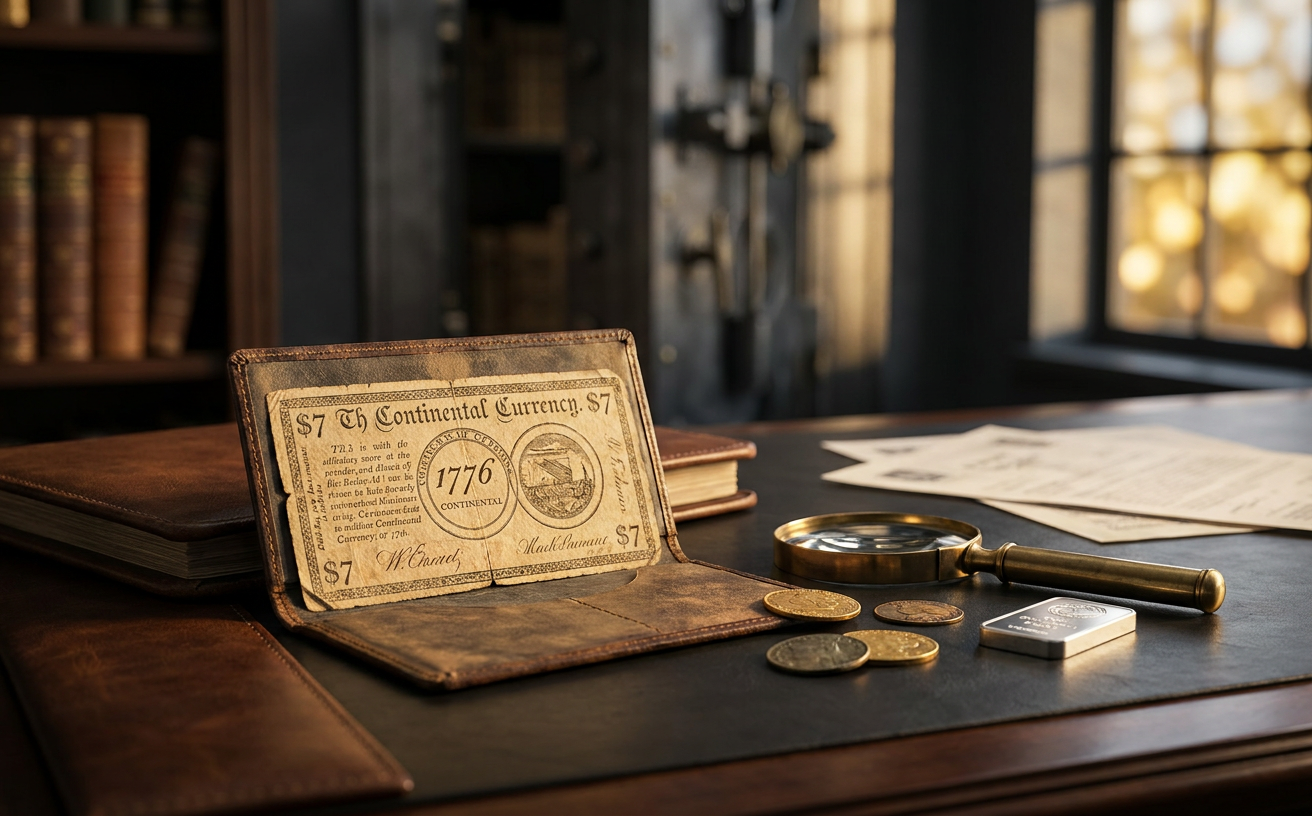
A recent discovery in the world of paper money provides a rare, tangible link to the American Revolution, connecting a soldier's payment to one of the nation's most prominent political families. A $7 Continental Currency note, issued in 1776, has been authenticated along with documentation verifying its continuous ownership within the extended family of Sergeant Frederick Taft, a Revolutionary War soldier. This extraordinary find, complete with a handwritten letter from 1843, offers a direct and personal connection to the financial history of America's founding.
-
A $7 Continental Currency note from February 17, 1776, has been discovered and certified by PCGS Banknote.
-
The note has a continuous and documented provenance, having remained within the same extended family since it was issued as pay to a Revolutionary War soldier.
-
Its history is confirmed by an 1843 letter written by the soldier's grandson, preserving the story for nearly two centuries.
-
The original owner, Sergeant Frederick Taft, was a distant relative of the family that produced U.S. President William Howard Taft.
-
This combination of the artifact, its story, and its connection to a famous American family makes it a significant numismatic find.
The Historical Context of Continental Currency
To finance the Revolutionary War, the Continental Congress faced a significant challenge. Lacking the authority to impose taxes, it resorted to one of the few tools at its disposal: issuing paper money. This currency, known as Continental Currency, was a promise of future payment, backed not by gold or silver, but by faith in the eventual success of the revolution. This specific $7 note was part of a $4 million authorization from February 17, 1776, a critical time just months before the Declaration of Independence was signed. While these notes were essential for funding the war effort, the massive quantity printed eventually led to severe inflation, with the phrase "not worth a Continental" becoming a common expression for worthlessness.
A Soldier's Pay and Its Meticulous Preservation
What elevates this particular note from a historical curiosity to a museum-quality artifact is its personal history. Documentation accompanying the note confirms it was issued to Sergeant Frederick Taft of Uxbridge, Massachusetts, as payment for his military service. While many Continental notes exist, very few can be traced to their original recipients. This note is an exception, thanks to Frederick Taft's grandson, Royal Sibley Warren.
In 1843, Warren, a physician who received the note from his grandfather, took the crucial step of documenting its origin. He wrote a letter, which was kept with the note inside an envelope, detailing that it was his grandfather's payment for service in the Revolution. This single act of preservation created an unbroken paper trail from 1776 to the present day, allowing the story to survive alongside the note itself.
The Taft Family Legacy
The name Taft carries significant weight in American history, adding another layer of interest to the note. The Taft family in America began with Robert Taft Sr. in the 17th century and established deep roots in Massachusetts. The family contributed soldiers to the Revolutionary War, including Sergeant Frederick Taft. His father, Samuel Taft, was a tavern owner in Uxbridge who was famously visited by George Washington in 1789.
Generations later, the family produced one of America's most distinguished public servants, William Howard Taft. He is the only individual to have served as both President of the United States (1909-1913) and Chief Justice of the Supreme Court (1921-1930). Genealogical records confirm that Sergeant Frederick Taft and President Taft were distantly related, both descending from the same colonial-era family. This connection links the humble soldier's payment to a presidential and judicial dynasty.
Why This Discovery Is Significant
The convergence of a historical artifact with a detailed human story is what makes this find so compelling for collectors and historians. The note is not merely a representation of wartime finance; it is the story of a specific soldier, his family's dedication to preserving his memory, and their connection to broader American history. The recent certification by PCGS Banknote of the note, the 1843 letter, and the original envelope confirms the authenticity of the entire package. It serves as a reminder that behind major historical events are personal stories, and occasionally, artifacts survive that allow us to touch that history directly.
What is Continental Currency?
Continental Currency was the paper money issued by the Continental Congress during the American Revolutionary War to fund the war effort. It was denominated in dollars and backed by the "anticipation" of future tax revenues, which ultimately led to hyperinflation.
What makes this $7 note so special?
Its significance comes from its documented provenance. We know the name of the Revolutionary War soldier who received it, and its history has been preserved by his family for nearly 250 years, as confirmed by an accompanying 1843 letter.
What is the note's connection to President Taft?
The original recipient, Sergeant Frederick Taft, was a distant relative of President William Howard Taft. They share a common ancestor, Robert Taft Sr., who settled in Massachusetts in the 17th century. The note connects the president's extended family to the nation's founding war.
This article is for educational purposes only and should not be considered investment advice. The value of numismatic items can be subjective and market-dependent. All investors should conduct their own research and consult with a qualified financial advisor before making any investment decisions.
Found this article helpful?
Take Our 1-Minute Gold IRA Match Quiz
Get a personalized recommendation based on your goals and investment style.
Explore Related Topics
For investors who don't have time to chase headlines.
Subscribe to The Precious Metals Report
Everything That Matters. Nothing That Doesn't.
No hype. No noise.
Just industry news — distilled into a short, scannable email.
✔ Price moves ✔ Market drivers ✔ Actionable insights

Vincent Edwards
Our editorial team covers numismatics for Precious Metals Report, focused on clear, unbiased reporting and investor education.
Read more from this author