Feuchtwanger Cent: The Private Token That Shaped US Coinage
Key Takeaways
- 1The Feuchtwanger Cent was a privately produced token proposed as a replacement for the official U.S. large cent in 1837.
- 2It was composed of "German silver," an alloy of copper, nickel, and zinc that contained no actual silver but had a silvery appearance.
- 3Though Congress rejected the proposal, the tokens were widely circulated and accepted by the public during a period of economic hardship and coin shortages.
- 4Today, the Feuchtwanger Cent is a popular collectible categorized as a "Hard Times token," representing a unique chapter in American monetary history.
- 5Its small size and eagle-forward design anticipated the official small cents, like the Flying Eagle cent, that the U.S. Mint would adopt two decades later.
In the 1830s, the United States faced a crisis of confidence and currency. The Panic of 1837 destabilized the economy, leading citizens to hoard precious metals like gold and silver. This created a severe shortage of circulating coins, making everyday transactions difficult. Into this environment stepped Dr. Lewis Feuchtwanger, a German immigrant and chemist with a revolutionary proposal to reform the nation’s coinage and solve the small-change problem.
A Man of Science and Commerce
Dr. Lewis Feuchtwanger, born in Bavaria in 1805, arrived in the United States in 1829. A trained chemist and mineralogist, he established a German pharmacy in New York City. His interests were broad; beyond his pharmacy, he was an importer, a publisher of scientific texts on gems and mineralogy, and an avid collector of natural and cultural artifacts. His expertise in metals provided the foundation for his numismatic experiment.
The Problem with the Penny
During this era, the official one-cent piece was the large cent, a bulky copper coin measuring approximately 27.5 millimeters in diameter. These coins were cumbersome for citizens to carry and, more importantly, were becoming unprofitable for the U.S. Mint to produce. The rising cost of copper meant the metallic value of the coin was approaching its face value, a situation that threatened the stability of the currency system. Feuchtwanger saw an opportunity for improvement. He developed a proprietary metal alloy he called "Feuchtwanger's Composition," which is also known as German silver. This alloy, primarily a mix of copper, nickel, and zinc, offered a clever solution. It had a bright, silver-like appearance, was more resistant to corrosion than pure copper, and was significantly cheaper to produce.
A Proposal for a Modern Cent
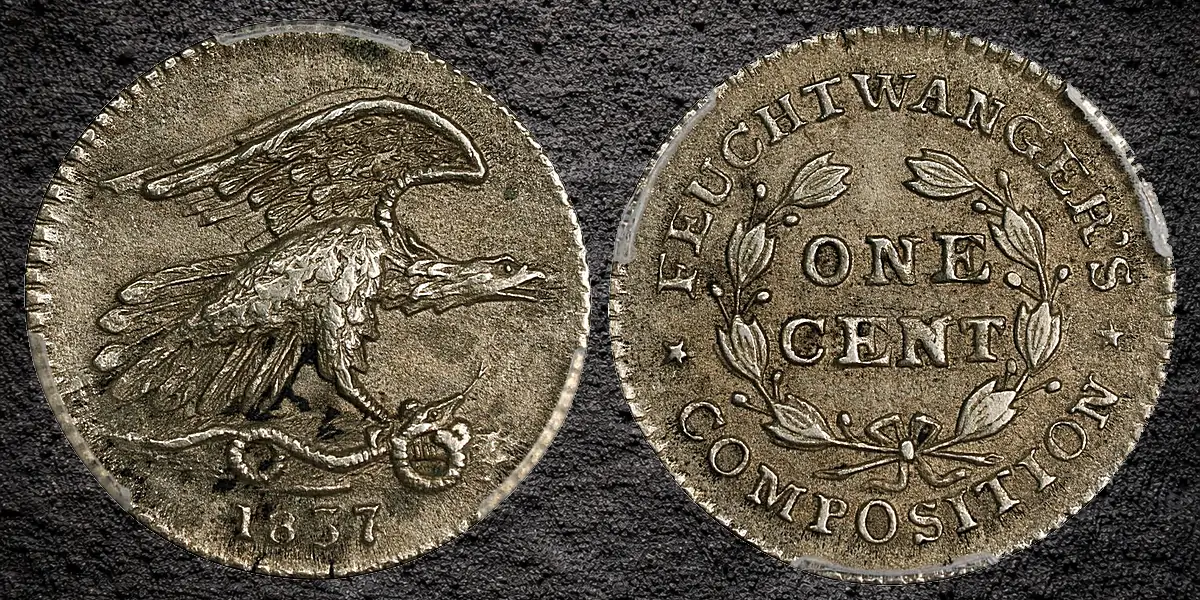
Armed with his new alloy, Feuchtwanger lobbied Congress to adopt it for the nation's one-cent coin. He proposed a much smaller and more convenient piece, measuring about 18.5 mm—similar in size to a modern dime. To demonstrate his concept, he minted pattern tokens to present to lawmakers. The design was striking and powerful. The obverse featured a bold eagle in flight, clutching a snake in its talons, with the date "1837" below. The reverse clearly stated the denomination "ONE CENT" within a wreath, encircled by the words "FEUCHTWANGER'S COMPOSITION." This eagle-and-snake motif remains one of the most distinctive and memorable designs in the field of American exonumia (tokens and medals).
Rejection by the Mint, Acceptance by the People
Despite gaining some political allies, including Senator Thomas Hart Benton of Missouri, Feuchtwanger's proposal was ultimately turned down. In 1838, Mint Director Robert Maskell Patterson formally rejected the idea of using the new alloy for federal coinage. This decision marked the end of Feuchtwanger's ambition for an official government contract. However, the story did not end there. The economic turmoil of the Panic of 1837 had created a vacuum in commerce that needed to be filled. With official small change being hoarded, the public was in desperate need of a medium for minor transactions. Feuchtwanger began issuing his one-cent tokens from his New York business, and they were readily accepted by merchants and the general populace. Over a million of these tokens are believed to have entered circulation, effectively becoming a form of privately issued money during a time of crisis.
Legacy as a Hard Times Token
Due to the era in which they were produced and used, Feuchtwanger Cents are classified by collectors as "Hard Times tokens." This series includes a wide variety of non-official tokens that circulated between roughly 1837 and 1844 to alleviate coin shortages. Many of these pieces also carried political messages related to the era's banking debates. The Feuchtwanger Cent circulated for years, with some examples reportedly still in use at the start of the Civil War. This long period of circulation means that many surviving specimens are well-worn. High-grade examples with sharp details can be challenging to find today. Numismatists have identified numerous varieties, with at least 14 recognized die combinations. The high-relief design of the eagle often resulted in a weak strike in the center, a technical detail collectors must consider when evaluating a token's condition. While it never became an official coin, Feuchtwanger's token was a visionary piece that proved the viability of a small-sized cent nearly two decades before the U.S. Mint replaced the large cent with the Flying Eagle cent in 1856.
The information provided here is for educational purposes only and should not be considered investment advice. The value of numismatic items can fluctuate, and investors should conduct their own research before making any purchasing decisions.
Source: 1837 Feuchtwanger Cent: The Tiny Token That Almost Changed U.S. Coinage
'''Found this article helpful?
Take Our 1-Minute Gold IRA Match Quiz
Get a personalized recommendation based on your goals and investment style.
Frequently Asked Questions
Explore Related Topics
For investors who don't have time to chase headlines.
Subscribe to The Precious Metals Report
Everything That Matters. Nothing That Doesn't.
No hype. No noise.
Just industry news — distilled into a short, scannable email.
✔ Price moves ✔ Market drivers ✔ Actionable insights

Vincent Edwards
Our editorial team covers numismatics for Precious Metals Report, focused on clear, unbiased reporting and investor education.
Read more from this author